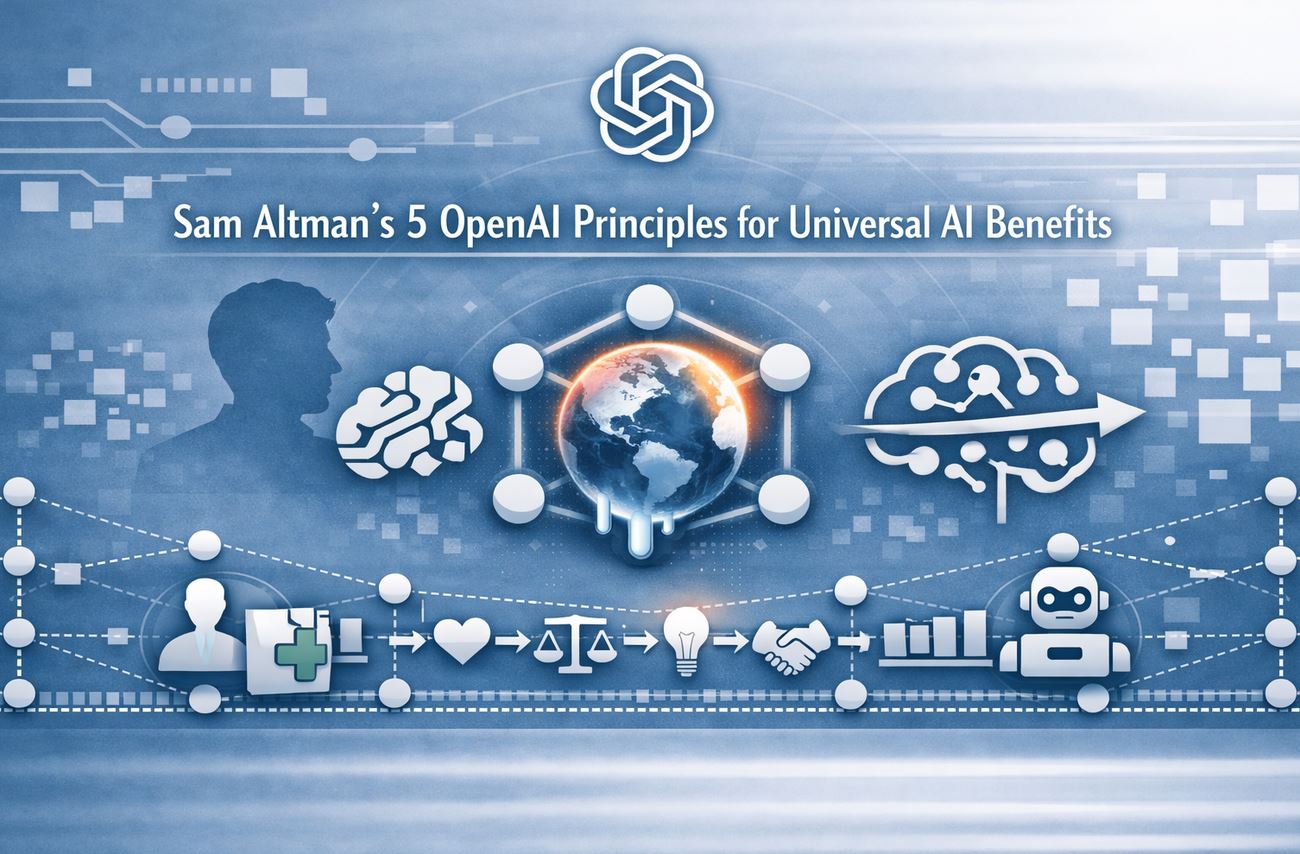
On April 27, 2026, OpenAI CEO Sam Altman shared a sweeping vision for the future of Artificial General Intelligence (AGI), positioning it as a force for decentralization rather than corporate consolidation.
Speaking on the company’s evolving role in global stability, Altman argued that AI will expand human freedom and capability more significantly than the steam engine or electricity combined. However, he warned that this “sci-fi reality” is not guaranteed. Without a deliberate framework, the power of superintelligence could fall into the hands of a small corporate elite—an outcome OpenAI’s new “Universal Benefit” principles are designed to prevent.
The Five Principles of OpenAI
Altman’s framework serves as a roadmap for navigating the transition from simple chatbots to agentic AGI. The mission, he states, is to move beyond the lab and into “democratic processes.”
1. Democratization
OpenAI pledges to oppose the concentration of power. Altman emphasized that key decisions about AI shouldn’t just happen in “neural network development labs,” but should be part of equal, democratic processes.
2. Empowerment
The goal is to provide a “personal super-tutor” and assistant for every human. By giving everyone access to high-performance AI, OpenAI believes individuals will be empowered to pursue dreams and self-realization that were previously economically or intellectually out of reach.
3. Universal Prosperity
Altman envisions a world where AI-driven scientific discoveries solve scarcity. To achieve this, he called for:
- Government Collaboration: Developing new economic models to ensure everyone participates in value creation.
- Massive Infrastructure: Rapidly scaling AI infrastructure to drive down the cost of intelligence to nearly zero.
4. Resilience
Altman acknowledged the “dark side” of the technology, specifically citing the potential for AI to simplify the creation of new pathogens or carry out advanced cyberattacks. OpenAI’s stance is that “no single lab can ensure a prosperous future.” Resilience requires collective action and the use of AI to defend critical infrastructure and open-source software.
5. Adaptability
OpenAI admits the future is unpredictable. Altman committed to “openly communicating” when the company must shift its principles. Notably, he stated that OpenAI is willing to sacrifice some individual empowerment if it is necessary to ensure greater global resilience.
The Shadow of the Past: A Question of Trust
While Altman’s vision is utopian, the announcement comes amidst a climate of skepticism. An 18-month investigation by The New Yorker, published recently, raised concerns about Altman’s leadership style, with journalists alleging a history of inconsistent transparency.
Altman addressed this shift in public perception indirectly, noting that the company “plays a much more significant role in the world today than a few years ago,” acknowledging the heavy burden of trust placed on OpenAI as it approaches AGI.
Impact Analysis: AI as a Utility
If these principles are followed, the 2026-2030 era could see AI transition from a “product” you buy to a “utility” you are born with.
| Principle | Impact for the Individual | Impact for Society |
|---|---|---|
| Democratization | Voice in how AI is governed. | Prevention of AI-monopolies. |
| Prosperity | Drastically lower cost of living. | Accelerated scientific breakthroughs. |
| Resilience | Protection from AI-driven hacks. | Global defense against bio-threats. |
Export to Sheets
Expert Insights: The Cost of Intelligence
Economists are particularly interested in Altman’s “Universal Prosperity” pillar. If AI truly drives down the cost of knowledge-work and scientific discovery, traditional GDP models may become obsolete. The push for “new economic models” suggests that OpenAI is actively preparing for a world where labor is no longer the primary driver of value—a concept often linked to Universal Basic Income (UBI) and high-abundance economies.
FAQs
1. Does OpenAI still aim for AGI?
Yes. Altman reiterated that the mission remains “to ensure that AGI benefits all of humanity.”
2. What are the “catastrophic risks” Altman mentioned?
He specifically highlighted the risk of AI-assisted bioweapon development and large-scale automated cyberwarfare against critical infrastructure.
3. How will OpenAI “decentralize” power?
By making powerful models accessible to everyone, rather than keeping them behind a high-priced corporate paywall, and by inviting government oversight into their operating principles.
4. What is the role of infrastructure?
Altman believes that for AI to be a universal right, the electricity and chips required to run it must become incredibly cheap and abundant.
Conclusion: The Vacuum of Leadership
Sam Altman’s principles are an attempt to fill the leadership vacuum in the AI space. By aligning OpenAI with “democratic processes” and “universal prosperity,” he is making a bid for public trust at a time when the technology is moving faster than the law. Whether these principles are a genuine philosophy or a strategic shield remains the biggest question of the AI era.
Action Item: Follow the development of AI infrastructure projects. As Altman noted, the “cost of construction” for the AI world will be the primary factor in whether prosperity is truly universal.
