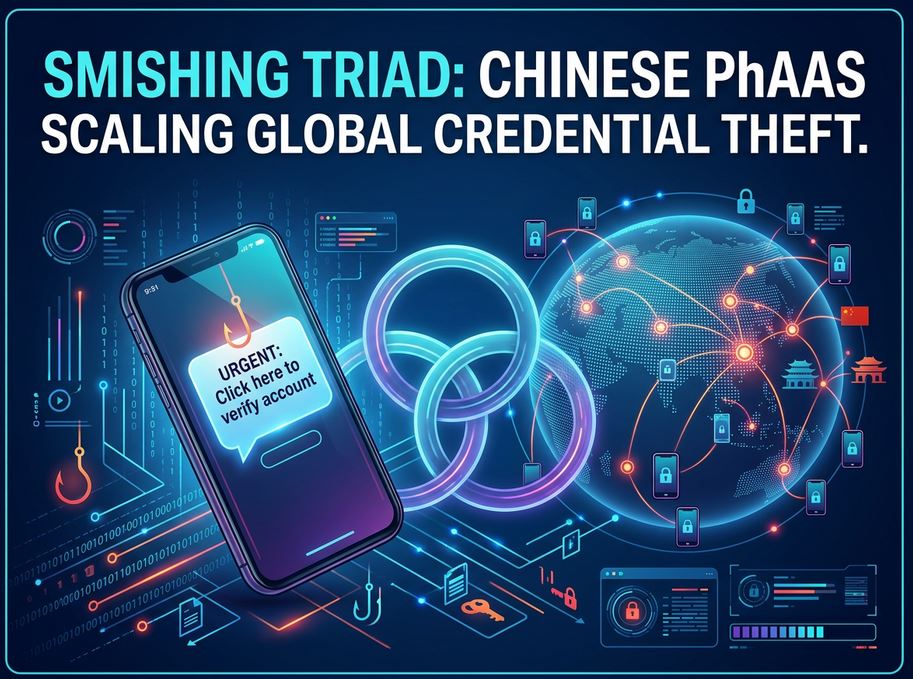
The traditional phishing email is being eclipsed by a more direct, intimate, and harder-to-detect threat: Over-the-Top (OTT) smishing. In a technical analysis published on April 27, 2026, researchers at urlscan.io alongside insights from Group-IB and Unit 42, have unmasked a sprawling “Phishing-as-a-Service” (PhaaS) ecosystem backed by Chinese-language operators. This network, often referred to as the Smishing Triad, is no longer a regional nuisance; it has become a global industrial complex for credential theft.
The PhaaS Revolution: Renting the “Perfect” Scam
Gone are the days when hackers had to build their own malicious pages. The Chinese-language PhaaS market now offers “all-in-one” subscription kits.
Why the Smishing Triad is Dominating:
- Ready-Made Kits: Criminals rent templates that perfectly mimic banks, postal services (like USPS or Royal Mail), and toll payment systems.
- Cross-Border Scalability: A single backend can support dozens of templates, allowing one operator to target victims in the U.S., UK, Australia, and Japan simultaneously.
- Technical Support: These platforms offer 24/7 technical assistance and real-time “harvesting dashboards” for stolen credit card data and OTPs.
Technical Delivery: Bypassing Filters with SIM Boxes and RCS
What makes these campaigns truly dangerous is their delivery mechanism. Attackers are moving away from commercial bulk-sending gateways, which are easily flagged, in favor of SIM Box infrastructure.
The SIM Box Advantage
A SIM box is a device that holds hundreds of physical SIM cards. By connecting these to the internet, attackers can:
- Mimic Real Users: Messages appear to come from legitimate, local mobile numbers, bypassing carrier-level spam filters.
- Distribute Load: Networks are deployed across multiple countries, making it nearly impossible for law enforcement to shut down the “brain” of the operation.
Exploiting iMessage and RCS
Attackers are increasingly leveraging iMessage (Apple) and RCS (Android). Because these messages travel over data (OTT) rather than traditional cellular SMS protocols, they often bypass the security firewalls implemented by mobile carriers. This gives the phishing lures a “trust” factor that traditional SMS lacks.+1
Global Impact: A Sharp Rise in Domain Abuse
Data from APWG and Microsoft indicates a massive spike in domain registrations linked to these Chinese frameworks. Since January 2024, over 194,000 malicious domains have been tied to this single ecosystem.
Common Lures in 2026:
- “Your package is awaiting delivery. Confirm your address now.”
- “Unpaid toll fee detected. Pay immediately to avoid penalties.”
- “Bank security alert: Verify your account within 30 minutes.”
Expert Insights: The Shift to Affiliate-Based Fraud
As a senior cybersecurity analyst, I see the Smishing Triad as a shift from “individual crime” to “corporate-style affiliate fraud.” They operate with the efficiency of a legitimate SaaS company.
Risk-Impact Analysis: The use of SIM box networks means that as soon as one node is taken down, another pops up using a new set of prepaid SIM cards. It is a game of “whack-a-mole” where the attacker has an infinite supply of hammers.
FAQs
Why is this called “Smishing”?
Smishing is a portmanteau of “SMS” and “Phishing.” It refers to any phishing attempt conducted via text message or mobile messaging apps like iMessage and WhatsApp.
How do they get my phone number?
Attackers buy massive databases from “upstream” data brokers who harvest numbers from social media leaks, old data breaches, and shady “marketing” lists.
Can my carrier block these messages?
Carriers are improving their filters, but SIM boxes make it difficult because the messages look like they are coming from a regular person’s phone.
Conclusion: Securing the Mobile Gateway
The explosion of Chinese-backed PhaaS proves that our mobile numbers are now our most vulnerable digital identifiers.
Immediate Recommendations:
- Verify, Don’t Click: If you get a “toll” or “package” alert, go to the official website or app manually. Never click the link in the message.
- Report Spam: Use your phone’s “Report Junk” feature. This helps Apple and Google improve their OTT filters.
- Monitor New Domains: Security teams should use tools like urlscan.io to monitor for new domains that spoof their corporate brand.
Is your mobile workforce protected from Smishing? [Download our 2026 Smishing Defense Blueprint] to learn how to implement carrier-agnostic message filtering.
