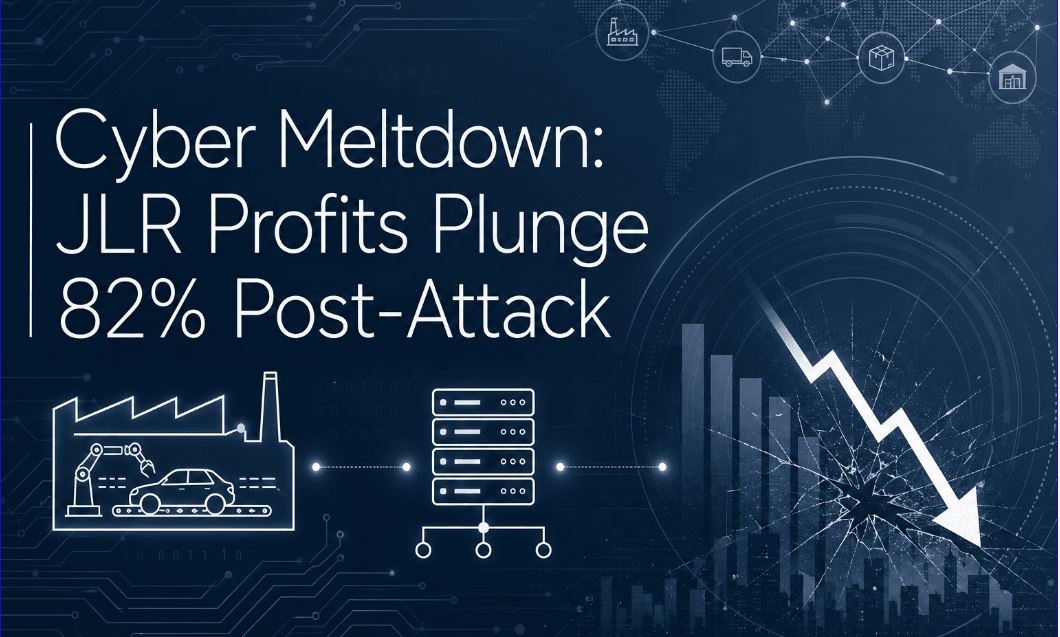
Automotive giant Jaguar Land Rover (JLR) is facing a severe financial reckoning. On May 16, 2026, the luxury vehicle manufacturer released its fourth-quarter and full-year financial reports, revealing a precipitous drop in sales and earnings directly linked to a catastrophic cyberattack that crippled its operations the previous year.
Despite factory production lines returning to regular operational capacity in early 2026, the financial damage sustained during the multi-week system blackout has severely dented JLR’s balance sheet. The figures illustrate a challenging year compounded by global economic pressures, including the planned phase-out of legacy models, fierce competitive shifts in the Chinese luxury market, and escalating US import tariffs.
The numbers released by JLR highlight the long-term impact of the breach:
- Fourth-Quarter Revenue: Slumped 11% year-on-year to £6.9 billion.
- Full-Year Revenue: Dropped 21% down to £22.9 billion.
- Fourth-Quarter Pre-Tax Profit: Plummeted by 48% to £458 million.
- Full-Year Pre-Tax Profit: Collapsed by a staggering 82%, falling to £2.5 billion.
The Attack Profile: Behind the ‘Digital Siege’
The systemic crisis began in August 2025, when threat actors orchestrated a massive intrusion into JLR’s internal IT environment. Security researchers believe the attackers capitalized on an unpatched vulnerability within SAP NetWeaver software—a flaw previously flagged by the US Cybersecurity and Infrastructure Security Agency (CISA)—to establish their initial beachhead.
Plaintext
SAP NetWeaver Flaw Exploited ➔ Core IT Infrastructure Compromised ➔ Emergency Shutdown of Production ➔ 6-Week Factory Freeze ➔ £1.5bn Gov Loan Guarantee Triggered
The incident was tied to the prolific ShinyHunters hacking collective and associated syndicates, whose multi-staged cyber extortion campaigns have continued to disrupt enterprise networks throughout 2025 and 2026.
To prevent the threat from migrating from administrative corporate networks straight into critical industrial automation layers, JLR executed an emergency shutdown. This defensive measure froze assembly lines across its primary UK manufacturing plants in Solihull, Halewood, and Wolverhampton for roughly six weeks.
The factory freeze halted the assembly of roughly 1,000 luxury vehicles per day, totaling an estimated cumulative production loss of 50,000 units. The operational stoppage quickly cascaded through the automotive supply ecosystem, threatening cash flows and forcing sub-tier suppliers to implement rolling staff furloughs.
The economic ripple effect grew so severe that the UK Government (Westminster) intervened, issuing a £1.5 billion emergency loan guarantee to stabilize the automotive supply chain across the West Midlands region.
Quantifying the Damage: A Category 3 Cyber Hurricane
The independent UK Cyber Monitoring Centre (CMC), which utilizes a standardized, weather-style “hurricane scale” to evaluate major digital disasters, has officially classified the JLR breach as a Category 3 Systemic Event.
According to the CMC’s actuarial modeling, the wider economic impact of this single breach is estimated between £1.6 billion and £2.1 billion, with the potential to scale up to £5 billion when accounting for indirect losses distributed across nearly 3,000 distinct UK organizations and component suppliers.
The CMC emphasized that virtually all financial losses stemmed from operational disruption rather than data exfiltration. This reinforces a growing shift in corporate threat landscapes: the modern cost of a prolonged business interruption dwarf traditional regulatory fines associated with standard data breaches.
The Leadership Pivot and the Road Ahead
In November 2025, amid the immediate fallout of the network freeze, JLR’s parent company, Tata Motors, appointed PB Balaji as the new chief executive to steady the ship. Balaji, previously the Chief Financial Officer of Tata Motors, immediately restructured internal governance, making each core brand division—Range Rover, Defender, Discovery, and Jaguar—individually accountable for its profit-and-loss metrics while elevating procurement security to a board-level priority.
“We recovered well in the fourth quarter as production returned to normal levels,” Balaji stated during the earnings release. “As we look ahead into FY27, we are focused on driving growth, accelerating our pure-electric vehicle transitions, and reducing our break‑even volumes.”
Defensive Directives: Board-Level Accountability
The financial devastation at JLR has reignited intense debates regarding corporate cyber governance across European markets. Keven Knight, CEO of cybersecurity firm Talion, warned that losses of this magnitude would completely erase most mid-market enterprises.
Knight pointed to the latest UK Government Cyber Security Breaches Survey, which revealed that only 31% of surveyed businesses feature board members who hold explicit, formal responsibility for cyber risk management.
To build systemic resilience against prolonged infrastructure outages, enterprise leadership must implement three structural defenses:
- Enforce Definitive IT/OT Air-Gapping: Ensure that manufacturing control loops and industrial robotics (Operational Technology) run on completely separate network planes from corporate email and enterprise resource planning (ERP) suites. This structural separation ensures that an IT-layer infection cannot paralyze factory floors.
- Conduct Cyber-Loss Financial Modeling: Corporate boards must look past basic compliance checklists and move toward quantitative cyber risk modeling. Leadership needs to calculate the precise weekly cost of total factory downtime to accurately structure insurance coverage and liquidity reserves.
- Audit Sub-Tier Supply Dependencies: Companies should map out the digital connections binding them to their key logistics and parts providers. A security failure at an upstream assembly plant can easily spark an inventory shortage down the line
