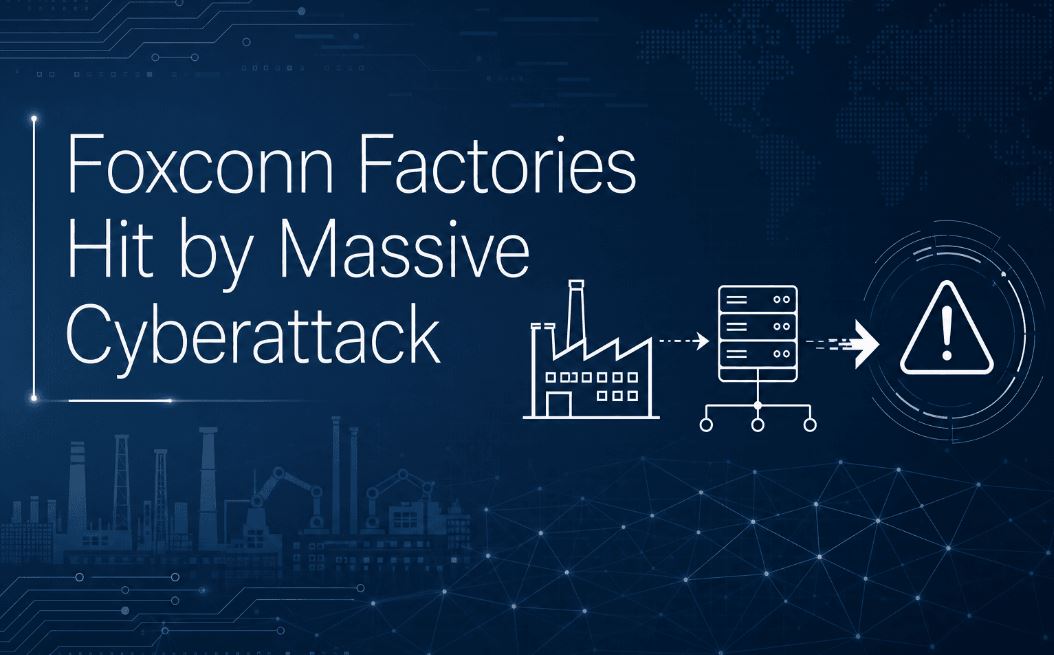
On May 14, 2026, electronics manufacturing giant Foxconn confirmed that several of its core production facilities across North America were struck by a disruptive cyberattack. The announcement came shortly after a known extortion syndicate publicly claimed responsibility for infiltrating the company’s internal network.
Foxconn—officially recognized as Hon Hai Precision Industry Co. and headquartered in Taiwan—occupies a critical node in the global consumer technology supply chain, bringing in a massive $259 billion in annual revenue. Best known as the primary assembler of Apple iPhones, Foxconn’s expansive North American operations span highly automated manufacturing hubs across Texas, Indiana, Virginia, Ohio, and major facilities in Mexico and Mount Pleasant, Wisconsin.
While Foxconn officials reported that emergency response protocols were immediately deployed to limit systemic downtime, threat intelligence analysts warn that the underlying data-theft claims could trigger significant downstream architectural security risks for the world’s most prominent technology vendors.
The Extortion Blueprint: 8 Terabytes of Proprietary Blueprints Exposed
The attack was claimed on the dark web by Nitrogen, a double-extortion ransomware organization that has aggressively targeted industrial sectors, tech companies, and critical supply chains since its emergence in mid-2023.
Plaintext
Malvertising / Compromised Driver ➔ Network Infiltration ➔ 8 Terabytes of Data Exfiltrated ➔ Industrial Systems Encrypted ➔ Double-Extortion Leak Post
The Nitrogen syndicate claims to have exfiltrated 8 terabytes of data encompassing over 11 million individual files from Foxconn’s file servers. To back up its claims, the group uploaded an array of proof-of-concept screenshots to its Tor leak site.
According to threat intelligence monitoring, the compromised files allegedly contain:
- Confidential internal instructions and assembly guidelines.
- Proprietary engineering blueprints and schematic drawings.
- System network topology diagrams mapped to specific corporate clients.
The attackers explicitly flagged high-profile Foxconn customers within the leak, asserting that they compromised intellectual property belonging to Apple, Nvidia, Intel, Google, and Dell Technologies. While none of these target organizations have issued formal statements regarding the validity of the leak, security analysts verifying early file samples noted the presence of authentic component layouts and hardware schematics.
The Threat Intel Profile: Inside the Nitrogen Syndicate
According to security researchers, Nitrogen is an evolutionary threat group. The operation originally launched using source code elements derived from ALPHV (BlackCat) and later integrated stolen code libraries from the defunct Conti syndicate to assemble its custom encryption binaries targeting Windows and VMware ESXi server environments.
“Nitrogen follows a consistent playbook, stealing data before encrypting systems so they have leverage on multiple fronts,” explained Ismael Valenzuela, Vice President of Threat Research and Intelligence at Arctic Wolf Labs.
Valenzuela noted that Nitrogen’s operational model intentionally avoids complex front-line defenses of massive enterprise headquarters. Instead, they seek out secondary supply chain links—such as regional industrial factories—which maintain vital operational pipelines but may feature less restrictive access control controls than the core tech companies they serve.
The Unpayable Ransom Caveat
A critical technical advisory published by forensic threat analysts introduces an unsettling twist to Nitrogen’s operational pattern: technical breakdowns of Nitrogen’s customized ESXi encryption tool reveal a severe cryptographic logic error in its key-management system.
Critical Advisory: Due to coding bugs inside the threat group’s Linux/VMware malware strain, the encryption process can inadvertently destroy its own decryption keys. This means that even if a victim succumbs to extortion and pays the ransom, the data often cannot be recovered.
This flaw has led researchers to speculate that Nitrogen may be shifting away from system recovery entirely, inflating data-theft claims to place maximum pressure on victims through public exposure rather than functional decryption.
The Downstream Fallout: Long-Term Risk Matrix
While a spokesperson for Foxconn confirmed that “affected factories are currently resuming normal production,” cybersecurity specialists emphasize that the real danger lies in the long-term utility of the exfiltrated corporate data.
The threat landscape resulting from an 8TB hardware manufacturing breach includes distinct secondary vectors:
- Exploitation of Firmware Flaws: Access to internal schematics and component topologies allows malicious actors to reverse-engineer hardware interfaces, accelerating the discovery of low-level firmware flaws that are exceptionally difficult to patch.
- Counterfeiting and Supply Chain Subversion: The exposure of high-fidelity blueprints provides rogue manufacturing entities with the exact specifications needed to produce highly convincing counterfeit chips or consumer electronics, opening up channels for hardware-level Trojan injections.
Defensive Directives for Vendor Risk Management (VRM)
The Foxconn incident moves the discussion from simple business interruption to systemic supply chain vulnerability. To counteract this evolving exposure, enterprise security organizations should adopt three foundational practices:
- Continuous Third-Party Perimeter Audits: Rather than relying on static, annual compliance assessments of supply vendors, organizations must use automated external scanning tools to monitor suppliers for critical security gaps, such as exposed remote desktop protocols (RDP) or outdated VPN infrastructure.
- Zero-Trust Network Segmentation: Production networks and intellectual property repositories shared with external suppliers must be highly segmented. Ensure that a security incident on an assembly partner’s corporate IT network cannot bridge into your core infrastructure.
- Establish Blast-Radius Resilience: Assume that upstream logistics providers will experience operational downtime. Maintain redundant hardware assembly pathways and diversified manufacturing options to offset regional operational disruptions.
