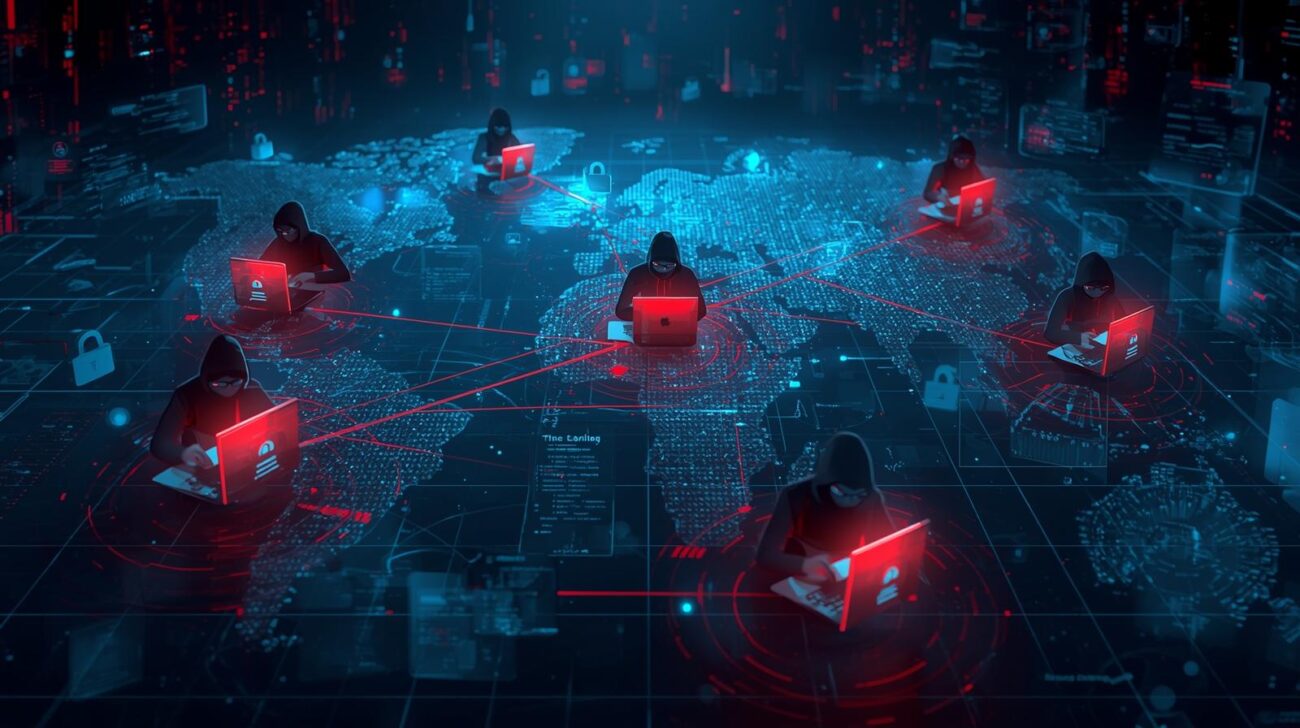
Threat actor collaboration is no longer theoretical — it’s actively reshaping the global cyber threat landscape. In 2025, incident response teams reported a sharp rise in multi-stage attacks involving multiple threat groups sharing access, tooling, and intelligence. For defenders, this means attacks are faster, stealthier, and far more adaptive.
Security teams have historically modeled cyber threats as separate actors operating independently. Ransomware groups chased profit. Nation-state actors pursued espionage. Hacktivists focused on disruption.
That model is now obsolete.
Today’s attackers operate more like fluid cyber alliances, forming short-term partnerships to maximize success. In this article, you’ll learn:
- What threat actor collaboration is and why it’s accelerating
- How collaborative cybercrime operations actually work
- Why defenders struggle to detect coordinated attacks
- Real-world examples and risk implications
- Practical defensive strategies aligned with NIST, MITRE ATT&CK, and Zero Trust
What Is Threat Actor Collaboration?
Threat actor collaboration refers to multiple adversary groups working together across parts of the attack lifecycle to increase success rates, reduce risk, and maximize profit or strategic impact.
Unlike traditional organized cybercrime groups, these alliances are often:
- Temporary
- Outcome-driven
- Role-specialized
- Economically motivated
Key Characteristics
| Characteristic | Traditional Threat Groups | Collaborative Threat Ecosystem |
|---|---|---|
| Structure | Fixed membership | Fluid partnerships |
| Skill Distribution | Generalist or centralized | Highly specialized |
| Attack Speed | Sequential | Parallelized |
| Attribution | Easier | Significantly harder |
Key takeaway:
Collaborative attackers behave more like supply chains than individual hacking teams.
How Collaborative Cyber Attacks Work
The Modern Attack Supply Chain
Today’s coordinated attacks often break into specialized phases:
1. Initial Access Brokers (IABs)
- Sell stolen credentials or network footholds
- Common techniques:
- Phishing
- Credential stuffing
- Exploiting edge devices
2. Post-Exploitation Specialists
- Privilege escalation
- Lateral movement
- Identity compromise
3. Monetization Operators
- Ransomware deployment
- Data extortion
- Access resale
This model mirrors legitimate SaaS ecosystems — specialization increases efficiency.
Why This Model Is So Effective
Economic Optimization
- Shared risk exposure
- Lower operational cost
- Faster campaign execution
Operational Advantages
- Shorter dwell time
- Harder attribution
- Rapid tool evolution
Detection Challenges
- Each phase appears low risk individually
- Full attack picture only visible retrospectively
Real-World Examples of Collaborative Threat Activity
Recent intelligence reporting has shown activity overlap between groups such as:
- ShinnyHunters
- LAPSUS$
- Scattered Spider
These actors have demonstrated:
- Shared infrastructure usage
- Reuse of credential access
- Tooling overlap
- Opportunistic cooperation
Example Scenario
A typical collaborative attack chain may look like:
- Access broker sells VPN credentials
- Another group performs AD privilege escalation
- Third group exfiltrates data and executes ransomware
Each actor may never interact directly — yet the attack is fully coordinated through underground markets and intelligence sharing.
The Blurring Line Between Cybercrime and Nation-State Activity
One of the most dangerous developments is capability crossover between criminal and state-linked operations.
Convergence Patterns
| Criminal → State | State → Criminal |
|---|---|
| Ransomware access reused for espionage | Advanced malware leaks into criminal ecosystem |
| Criminal infrastructure used for covert ops | Nation-state tooling repurposed for profit |
Why This Matters for CISOs
- Attribution becomes unreliable
- Regulatory reporting becomes harder
- Incident response scope must expand
- Risk impact increases dramatically
Key Insight:
Defenders must track behaviors and TTPs, not just group names.
Why Defenders Are Falling Behind
1. Intelligence Silos
Many organizations still treat threat intelligence as proprietary rather than operational.
Problems include:
- Vendor data fragmentation
- Industry sharing limitations
- Lack of real-time contextualization
Attackers combine intelligence globally.
Defenders often analyze locally.
2. Detection Speed vs Attack Speed
Modern attacks can complete initial compromise in minutes.
Typical defensive pipeline delay:
- Endpoint telemetry collection
- SIEM ingestion
- Detection logic execution
- Analyst triage
By the time alerts are reviewed, attackers may already have:
- Established persistence
- Exfiltrated data
- Disabled logging
3. Over-Reliance on Assumed Control Effectiveness
Many organizations deploy security tools but rarely validate them against real attacker behavior.
Without continuous validation:
- Controls may be misconfigured
- Detection gaps remain hidden
- Response playbooks become outdated
Common Misconceptions About Threat Actor Collaboration
❌ “These are permanent mega-groups”
Reality: Most alliances are temporary and transactional.
❌ “Only advanced attackers collaborate”
Reality: Even mid-tier cybercriminals participate via marketplaces.
❌ “More tools equals better defense”
Reality: Visibility and validation matter more than tool quantity.
Best Practices to Defend Against Collaborative Threat Actors
1. Adopt Behavior-Based Threat Detection
Focus on:
- Identity anomalies
- Privilege escalation chains
- Lateral movement patterns
Framework alignment:
- MITRE ATT&CK mapping
- UEBA-driven detection
- Cloud workload behavior monitoring
2. Operationalize Threat Intelligence
Move from static reports to:
- Automated IOC ingestion
- Real-time enrichment
- Contextual risk scoring
Best practice stack:
- TIP platform integration
- SOAR-driven automation
- Cross-cloud telemetry correlation
3. Implement Zero Trust Security Architecture
Zero Trust reduces collaboration benefits by limiting lateral movement.
Core pillars:
- Identity-first access control
- Continuous device validation
- Microsegmentation
- Least privilege enforcement
4. Continuously Validate Security Controls
Use:
- Breach and attack simulation (BAS)
- Purple team exercises
- Adversary emulation
Standards alignment:
- NIST SP 800-53
- NIST CSF Detect & Respond functions
- ISO 27001 Annex A monitoring controls
5. Improve Incident Response Readiness
Modern IR requires:
- Cloud + identity incident playbooks
- Cross-team crisis workflows
- Rapid containment automation
Tools, Frameworks, and Standards That Matter
MITRE ATT&CK
Essential for mapping multi-stage collaborative attack chains.
NIST Cybersecurity Framework
Provides structured detection and response maturity roadmap.
ISO 27001 / 27002
Supports governance and audit readiness.
Zero Trust Reference Architectures
Critical for limiting blast radius of shared access.
Risk Impact Analysis
Business Risks
- Faster breach timelines
- Higher extortion costs
- Larger data exposure scope
Technical Risks
- Detection evasion via distributed TTPs
- Toolchain polymorphism
- Cross-environment attack pivoting
Compliance Risks
- GDPR breach reporting complexity
- Supply chain security obligations
- Third-party risk amplification
FAQs
What is threat actor collaboration in cybersecurity?
Threat actor collaboration is when multiple adversary groups work together during different stages of an attack to increase success rates and reduce detection risk.
Why are collaborative cyber attacks harder to detect?
Because each stage often appears benign in isolation. Only combined telemetry reveals the full attack chain.
How does Zero Trust help against collaborative attackers?
Zero Trust limits lateral movement and prevents attackers from reusing shared access across environments.
Are ransomware groups working with nation-state actors?
In some cases, yes. Tooling, infrastructure, and access pathways can overlap between criminal and state-linked operations.
What framework helps track multi-stage collaborative attacks?
MITRE ATT&CK is the most widely used framework for mapping coordinated adversary behavior.
Conclusion
Cyber threats are no longer isolated operations. They are coordinated campaigns built from shared access, intelligence, and tooling.
The rise of threat actor collaboration represents a structural shift — not a temporary trend. Attackers are optimizing like businesses, forming alliances that improve efficiency, reduce risk, and increase impact.
Organizations that continue defending against isolated threats will fall behind.
Key Actions to Prioritize:
- Operationalize threat intelligence
- Validate controls continuously
- Deploy Zero Trust architectures
- Focus on behavior-based detection
Next Step:
Assess whether your current detection and response strategy can identify multi-stage collaborative attacks — before attackers test it for you.
