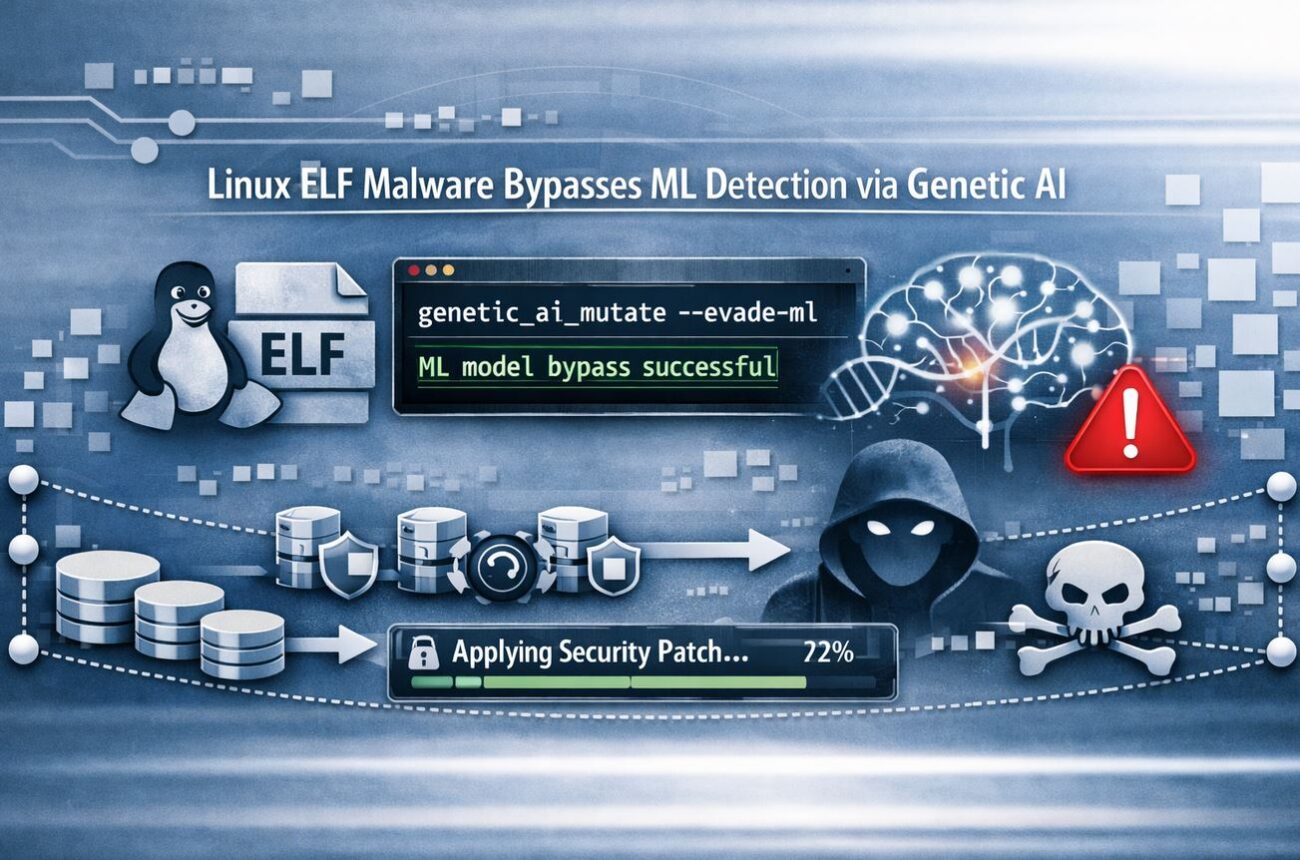
The security industry has long relied on Machine Learning (ML) as the “silver bullet” for detecting sophisticated threats. However, recent research from the Czech Technical University in Prague has exposed a significant crack in that armor.
While adversarial attacks on Windows PE files are well-documented, a new study published on arXiv (April 24, 2026) by Lukáš Hrdonka and Martin Jurecek reveals a highly effective malware generator targeting Linux ELF binaries. This tool doesn’t just bypass traditional signatures; it systematically “tricks” deep learning models into misclassifying malicious code as benign, achieving a staggering 67.74% evasion rate.
The Linux Blind Spot: Why ELF Binaries Are at Risk
Most adversarial research focuses on Windows, yet Linux is the backbone of modern enterprise infrastructure. It powers:
- Cloud Infrastructure: Containers, Kubernetes clusters, and web servers.
- IoT Devices: Smart sensors and industrial control systems.
- High-Performance Computing (HPC): Supercomputers and research clusters.
The researchers identified that as Linux adoption grows, so does the risk of adversarial evasion. If an attacker can mask a Linux-based ransomware or backdoor to look like a legitimate system utility, the impact on cloud workloads could be catastrophic.
How the Genetic Algorithm Generator Works
The core of the Czech researchers’ work is a Genetic Algorithm (GA) workflow. Unlike static obfuscation, this generator evolves the malware over multiple “generations” to find the most deceptive version of the file.
1. Semantic Preservation: The Golden Rule
The generator operates on the principle of semantic preservation. This means it modifies the static structure of the ELF (Executable and Linkable Format) binary without breaking its functionality. If the malware fails to execute, the evasion is considered a failure.
2. The Mutation Engine
The generator applies 12 distinct modification types across 7 different data sources. These include:
- String Injection: Inserting legitimate, “good-ware” strings into the binary.
- Section Reordering: Shifting headers and data blocks in ways that don’t affect runtime logic.
- Metadata Manipulation: Changing non-executable parts of the ELF structure.
3. Exploiting MalConv’s Vulnerabilities
The team targeted MalConv, a widely used deep learning architecture designed for end-to-end malware detection. They discovered that MalConv is highly sensitive to specific strings. By injecting benign strings—regardless of where they were placed (beginning, middle, or end)—the generator successfully shifted the model’s confidence.
Key Metrics: Measuring the “Confidence Shift”
The study goes beyond simple “Success vs. Failure” metrics. The researchers introduced two new ways to measure how badly an ML model is failing:
- Extended Evasion Rate (EER): A more nuanced view of how diverse modifications impact detection.
- Confidence-Shift Measurement: This measures the “certainty” of the detector.
On average, the generator reduced MalConv’s malware classification confidence by -0.50. In practical terms, this pushes a model that is “99% sure” a file is malware down into the “uncertain” or “benign” category, effectively silencing the alarm.
| Metric | Result |
|---|---|
| Primary Evasion Rate | 67.74% |
| Mean Confidence Shift | -0.50 |
| Comparison (ADVeRL-ELF) | 59.50% |
Export to Sheets
Defending Against Adversarial Linux Malware
For CISOs and SOC analysts, this research is a call to move beyond “ML-only” security stacks. Relying on a single deep learning model for Linux endpoint security is no longer sufficient.
1. Layered Defense (Defense in Depth)
Don’t abandon ML, but supplement it. Use Behavioral Analysis (monitoring what the file does at runtime) alongside static ML detection. An adversarial binary might look like a text editor, but if it starts encrypting the /home directory, behavioral rules will catch it.
2. Adversarial Retraining
Security teams should use generators like the one developed at the Czech Technical University to create “synthetic” adversarial samples. By training your ML models on these mutated binaries, you can close the gap and improve detection for future attacks.
3. Signature-Based Fallbacks
While often considered “old school,” traditional YARA rules and signature-based detection can catch known malicious payloads that have been modified just enough to slip past an ML classifier but still retain identifiable code snippets.
Expert Insights: The AI Arms Race
This research marks a significant jump from previous frameworks like ADVeRL-ELF, which hit a 59.5% success rate. By reaching nearly 68%, this new genetic algorithm approach proves that Linux environments—specifically containers and cloud workloads—are now primary targets for adversarial evasion.
Risk-Impact Analysis: The ability to inject benign strings anywhere in an ELF file means attackers don’t need deep knowledge of the file’s internal structure. This lowers the barrier to entry for creating evasive malware.
FAQs
What is an ELF binary?
ELF (Executable and Linkable Format) is the standard file format for executables, object code, and shared libraries on Linux systems.
Why is MalConv targeted?
MalConv is a benchmark deep learning model in the security community. Because it looks at the raw byte sequence of a file, it is a perfect target for testing how “semantic-preserving” changes can confuse an AI.
Is this attack “Remote” or “Local”?
This is an evasion attack. It assumes the attacker already has a way to deliver the file (e.g., via a phishing link or an insecure upload); the generator’s job is to ensure the file isn’t flagged by the antivirus/EDR once it arrives.
How can I protect my Linux servers?
Update your security tools to versions that use adversarial training and ensure you have runtime protection (like eBPF-based monitoring) to catch malicious behavior that static scans might miss.
Conclusion: Adapting to the Adversarial Era
The work by Hrdonka and Jurecek is a clear signal that the “detection gap” in Linux is closing—for attackers. As Linux continues to dominate the cloud and IoT sectors, the need for robust, multi-layered, and adversarial-aware defense systems is paramount.
Action Item: Review your Linux security posture. If your EDR relies solely on static ML classification, it’s time to integrate behavioral telemetry and adversarial retraining.
