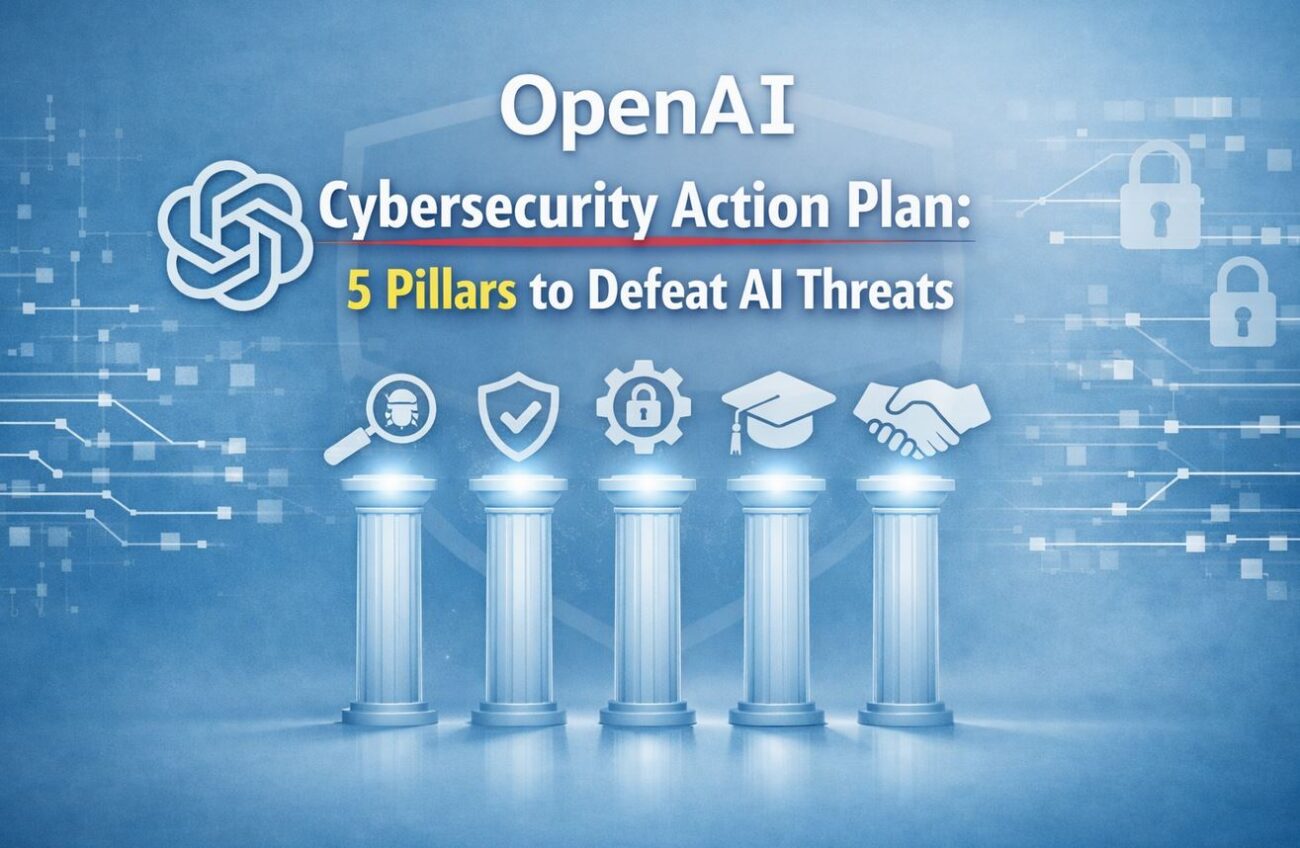
As malicious actors weaponize AI to automate phishing and scale ransomware, the gap between attackers and defenders is widening. On April 29, 2026, OpenAI responded with a landmark strategy: “Cybersecurity in the Intelligence Age.” +1
The plan outlines a framework of “controlled acceleration”—the rapid deployment of elite AI tools to vetted defenders to reclaim the strategic advantage from adversaries. “AI intensifies the reality for defenders and attackers alike,” OpenAI stated, “and private-sector innovators have a responsibility to meet that challenge.”
The 5-Pillar Strategy for AI Defense
OpenAI’s roadmap focuses on moving beyond simple chatbots to integrated, high-permissive security agents.
1. Democratizing Cyber Defense (The TAC Program)
The cornerstone of the plan is the Trusted Access for Cyber (TAC) program. It creates a tiered system where vetted defenders—from independent researchers to critical infrastructure operators—get access to more powerful, “cyber-permissive” models. +1
- GPT-5.4-Cyber: OpenAI recently launched this specialized variant, optimized for binary reverse engineering and vulnerability research.
- Broad Reach: The program is expanding to reach “downstream” defenders like small hospitals, school districts, and local water utilities through trusted partners like CISA and MSSPs.
2. Government and Industry Coordination
OpenAI is plugging into existing national security frameworks to share operational threat intelligence in real-time. This includes:
- Establishing a real-time AI-enabled coordination hub for sharing tradecraft and targeting patterns.
- Strengthening cross-lab information sharing via the Frontier Model Forum.
3. Protecting Frontier Capabilities
To prevent state-sponsored theft of its models, OpenAI is hardening its own “fortress.”
- Insider Risk Management: Using AI-driven anomaly detection to monitor privileged access.
- Microsoft Partnership: An expanded collaboration focused on protecting the shared hardware and software supply chains that power the world’s most advanced models.
4. Risk-Based Visibility and Control
Deployment is no longer a “one-size-fits-all” switch. OpenAI’s new framework uses tiered access based on:
- User Identity: Rigorous vetting for those using high-capability models.
- Real-Time Safeguards: Monitoring API calls to detect attempts to generate malicious exploits, allowing OpenAI to revoke access instantly if misuse is detected.
5. Empowering the Individual
Security must start at the kitchen table. With ChatGPT already handling 15 million security-related queries a month, OpenAI is rolling out:
- Native Security Features: Built-in tools to help seniors and parents identify phishing and scams.
- Stronger Hygiene Tools: Simplifying complex security practices for small businesses and households.
The Impact: AI as a Force Multiplier
Early data shows this approach is already working. OpenAI’s Codex Security—an AI agent that monitors codebases—has already contributed to fixing over 3,000 critical and high-severity vulnerabilities across 1,000+ open-source projects.
By shifting from “episodic audits” to continuous, AI-driven risk reduction, OpenAI believes the defensive community can finally move faster than the hackers.
Remediation: How to Get Involved
For organizations looking to leverage these new capabilities:
- Apply for TAC: Verified security professionals can apply for access at
[openai.com/form/enterprise-trusted-access-for-cyber](https://openai.com/form/enterprise-trusted-access-for-cyber). - Utilize GPT-5.4-Cyber: Teams in the program can now access models with lowered refusal thresholds for legitimate malware analysis.
- Audit via Codex: Open-source maintainers should integrate OpenAI’s free security scanning tools into their GitHub workflows.
Conclusion: A Window of Opportunity
OpenAI views the current moment as a “critical window” for the U.S. and its allies to convert their lead in AI into a permanent defensive shield. As the “Intelligence Age” accelerates, the goal is simple: ensure that the most powerful tools are always in the hands of the people protecting us.
