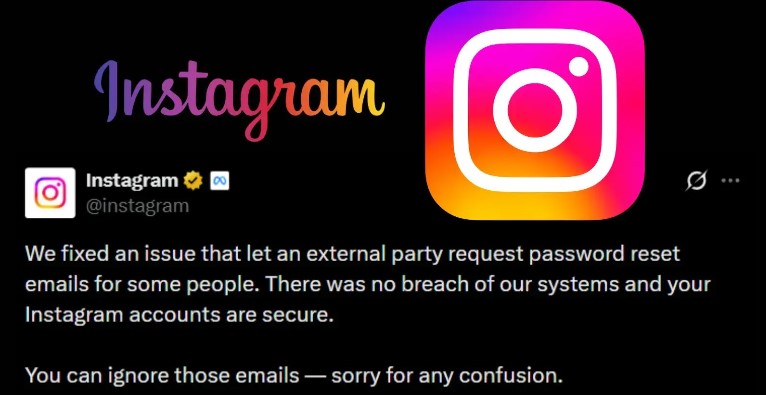
Instagram has clarified that its internal systems were not breached following reports from users who received unsolicited password reset emails.
According to the company, the incidents were the result of an external party exploiting a vulnerability that has since been patched. The flaw allowed attackers to trigger legitimate password reset emails without gaining access to user accounts or compromising Instagram’s core infrastructure.
Instagram emphasized that user accounts remain secure and advised affected individuals that unexpected password reset emails can be safely ignored.
Context: Password Reset Emails and Broader Data Exposure
The clarification comes amid heightened concern following reports of a data leak involving approximately 17.5 million Instagram accounts, with records reportedly advertised on dark web forums.
The exposed dataset allegedly contains:
- Usernames
- Email addresses
- Phone numbers
- Partial location information
While Instagram maintains that the password reset issue was unrelated to a breach of its systems, security professionals note that leaked contact information can be weaponized to amplify platform-level abuse, phishing attempts, and social engineering campaigns.
Vulnerability Details and Instagram’s Response
In an official statement, Instagram acknowledged that it had “fixed an issue that let an external party request password reset emails for some people.”
The company reiterated that:
- There was no breach of Instagram’s systems
- Attackers could not change passwords
- No unauthorized account access was possible
- The issue was limited to triggering reset emails
Rather than enabling direct compromise, the flaw allowed threat actors to generate disruption and confusion—potentially serving as a harassment vector or precursor to phishing attacks.
Instagram instructed users to ignore unexpected password reset emails and reminded them not to click links from suspicious messages that appear to exploit recent security news.
Increased Risk From Combined Threat Activity
Security researchers have pointed out that the timing of the vulnerability disclosure—coinciding with the circulation of a 17.5 million‑record dataset—could indicate a coordinated effort by threat actors.
With access to real email addresses and phone numbers, attackers may have been able to:
- Target specific users with reset requests
- Increase credibility of phishing messages
- Exploit user confusion during heightened media attention
While Instagram insists its infrastructure was not compromised, analysts warn that the combination of data scraping and platform flaws can materially increase user risk, even in the absence of direct account takeover.
Recommended Security Measures for Users
In response to the incident, security experts recommend that Instagram users take additional steps to safeguard their accounts, including:
- Enabling two‑factor authentication (2FA)
- Using strong, unique passwords not shared across platforms
- Remaining cautious of emails or messages referencing recent security incidents
- Monitoring accounts for unusual activity or login alerts
Users are also encouraged to periodically review account security settings and revoke access to unused third‑party applications.
Broader Implications for Platform Security
The incident highlights how non‑intrusive flaws, even those that do not result in direct breaches, can still be leveraged to scale abuse and social engineering.
As large social platforms continue to face data scraping, credential exposure, and automated abuse, security teams are increasingly tasked with addressing not only breaches—but also secondary exploitation risks tied to exposed personal data.
For users, the event serves as a reminder that multi‑layered security practices remain essential in an ecosystem where leaked data and opportunistic vulnerabilities can intersect.
