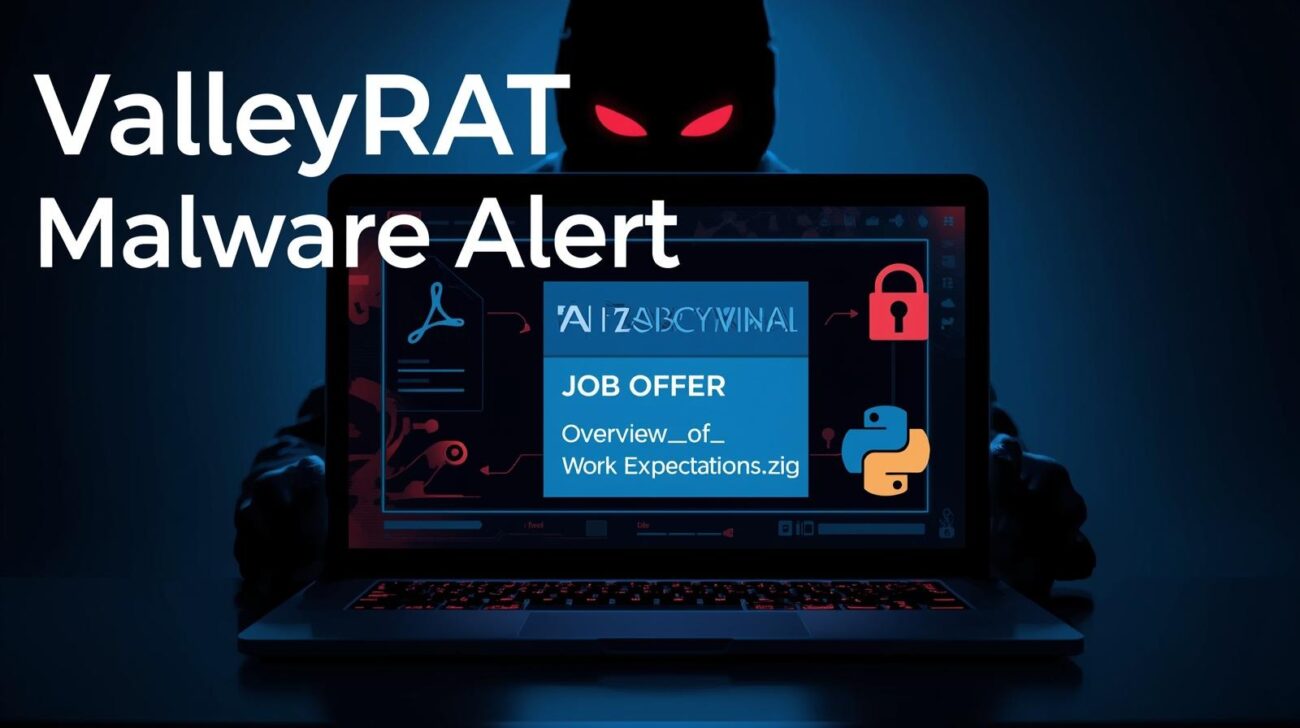
Cybercriminals have launched a sophisticated malware campaign called ValleyRAT, preying on job seekers through fake recruitment documents that look legitimate but hide a dangerous remote access trojan (RAT). This attack combines social engineering with advanced technical tricks to compromise systems and steal sensitive data.
The Perfect Lure: Fake Job Offers
The ValleyRAT campaign begins with emails containing fake job offers and company materials. These messages include compressed archive files with professional-sounding names such as:
- Overview_of_Work_Expectations.zip
- Candidate_Skills_Assessment_Test.rar
These filenames are designed to appear authentic, lowering suspicion among job seekers eager for employment opportunities.
The Foxit PDF Reader Deception
Inside each archive is a disguised executable file that mimics Foxit PDF Reader, a popular PDF application. The file even uses the official Foxit icon, making victims believe they are opening a simple document. In reality, they are launching malware that silently installs ValleyRAT.
This clever use of brand trust is a hallmark of modern cybercrime—leveraging familiar software to bypass user caution.
Technical Sophistication: DLL Side-Loading
ValleyRAT doesn’t rely on obvious malware signatures. Instead, it uses DLL side-loading, a technique that exploits Windows’ file search mechanism to load malicious libraries without triggering alarms.
Here’s the infection chain:
- Victim clicks the fake Foxit executable.
- Windows loads a malicious DLL (msimg32.dll).
- A hidden batch script extracts a Python environment from document files.
- Python downloads and executes a malicious script containing shellcode.
- ValleyRAT trojan installs and creates registry entries for persistence.
This multi-step process ensures stealth and resilience, making detection difficult for traditional antivirus tools.
What ValleyRAT Can Do
Once installed, ValleyRAT operates silently, granting attackers full control over the infected system. Its capabilities include:
✅ Monitoring user activity
✅ Stealing browser credentials and passwords
✅ Extracting sensitive financial and identity data
✅ Maintaining persistence across system restarts
Trend Micro researchers observed a significant spike in ValleyRAT detections in late October, signaling an aggressive expansion of this campaign.
Why Job Seekers Are Prime Targets
The attack leverages social engineering, exploiting the urgency and stress of job hunting. Victims are less cautious when downloading files that promise employment opportunities. Fake folder structures and hidden directories add layers of confusion, helping the malware evade detection while victims view convincing job postings.
The Bigger Picture
ValleyRAT is part of a growing trend where cybercriminals combine psychological manipulation with technical sophistication. By targeting job seekers and HR professionals, attackers gain access to personal data, corporate systems, and financial credentials—making this threat both personal and organizational.
How to Protect Yourself
- Verify email sources before downloading attachments.
- Avoid opening ZIP/RAR files from unknown recruiters.
- Keep PDF readers and software updated.
- Use endpoint security tools to detect DLL side-loading.
- Enable multi-factor authentication to protect accounts.
