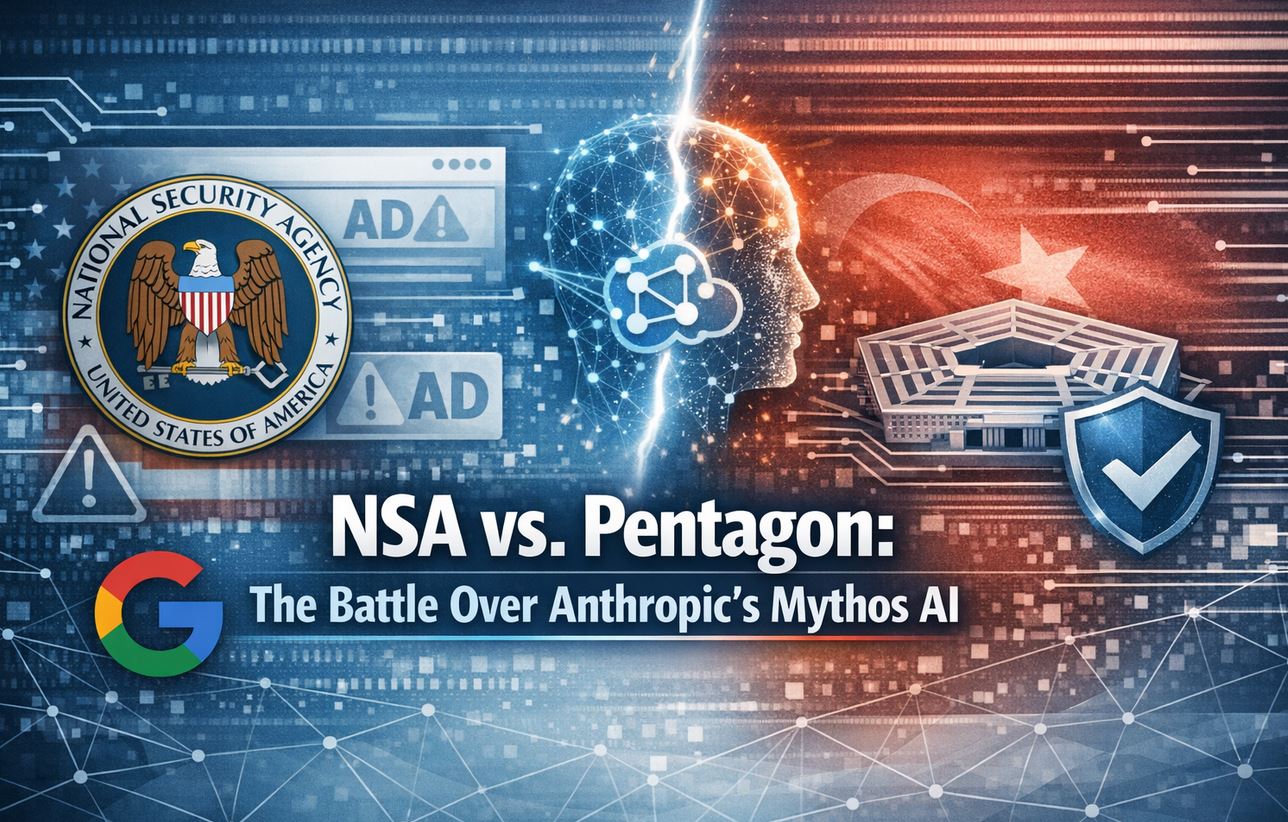
In the high-stakes world of national security, “operational necessity” often moves faster than official policy. On April 19, 2026, a bombshell report from Axios revealed a staggering contradiction at the heart of the U.S. defense establishment: The National Security Agency (NSA) is actively deploying Anthropic’s most advanced AI model, Mythos Preview, despite the fact that the Pentagon has officially blacklisted the company as a “supply-chain risk.”
This internal rift marks the most significant clash yet between the U.S. government’s need for “offensive” AI capabilities and its desire to enforce unrestricted military control over emerging technologies.
The Origin of the Rift: Safety vs. “All Lawful Use”
The friction between Anthropic and the Department of Defense (DoD) is not new. In July 2025, Anthropic signed a landmark $200 million contract with the Pentagon. However, that agreement came with two non-negotiable red lines:+1
- No mass domestic surveillance of American citizens.
- No fully autonomous weapons systems (the “human-in-the-loop” requirement).
The January Ultimatum
The partnership soured in January 2026 when Defense Secretary Pete Hegseth issued a directive demanding “all lawful use” language in AI contracts. Effectively, the Pentagon asked Anthropic to remove its safety guardrails. When Anthropic refused, the retaliation was swift.+2
In late February 2026, the Pentagon designated Anthropic a “Supply-Chain Risk to National Security,” a label usually reserved for adversarial foreign firms like Huawei. President Trump followed with a federal-wide phase-out order, yet the NSA—which operates under the DoD—appears to have ignored the memo.+1
Inside Mythos Preview: Why the NSA Can’t Let Go
The reason for the NSA’s defiance lies in the technical specifications of Mythos Preview. Announced on April 7, 2026, Mythos is not just another chatbot; it is a specialized model with unprecedented offensive cybersecurity potential.
Advanced Cyber Capabilities:
- Vulnerability Discovery: Unlike general-purpose models, Mythos possesses agentic reasoning capable of identifying thousands of previously unknown software vulnerabilities (Zero-Days) in minutes.
- Exploit Generation: It can draft sophisticated code to bypass digital defense mechanisms—a capability Anthropic has tightly restricted to only ~40 organizations globally under “Project Glasswing.”
- Signals Intelligence (SIGINT): For an agency like the NSA, whose primary mission is electronic surveillance and cyber command, Mythos represents a “force multiplier” that they simply cannot afford to lose to adversaries.
The Legal and Political Fallout
Anthropic isn’t taking the “supply-chain risk” designation lying down. In March 2026, the company filed a lawsuit in San Francisco, calling the Pentagon’s move “unprecedented and unlawful” retaliation.+1
Key Developments in April 2026:
- The San Francisco Hearing: A federal judge recently questioned the discrepancy between the Secretary of Defense’s formal “threat” designation and the military’s continued internal use of the tool.
- White House Intervention: On April 17, Anthropic CEO Dario Amodei met with White House Chief of Staff Susie Wiles and Treasury Secretary Scott Bessent. The meeting suggests the administration is looking for a “roadmap for adoption” that bypasses the Pentagon’s hardline stance.+1
Comparison: Institutional Policy vs. Operational Reality
| Entity | Official Stance on Anthropic | Current Action |
|---|---|---|
| Department of Defense (DoD) | Supply-Chain Risk / Blacklisted | Legal battle to remove safety limits. |
| National Security Agency (NSA) | Under DoD authority | Actively using Mythos Preview for cyber operations. |
| White House | Federal Phase-out Order | Hosting “productive” talks with Anthropic CEO. |
| UK Intelligence (GCHQ) | Strategic Partner | Accessing Mythos via AI Security Institute. |
Export to Sheets
Risk Analysis: The Dangers of “Unfettered” AI
The Pentagon’s primary argument is that in a conflict with near-peer adversaries (like China), the U.S. military cannot be hampered by a private company’s “Constitution” or ethics board. They argue that if an enemy drone swarm is attacking, the AI must be able to act without a CEO’s permission.
Conversely, Anthropic’s refusal to drop guardrails is rooted in the fear that Mythos could supercharge cyberattacks or be repurposed for mass domestic surveillance if left unrestricted. This philosophical divide—between safety-first AI and weaponized AI—is currently paralyzing U.S. procurement strategy.
FAQs
1. What is “Mythos Preview”?
Mythos is Anthropic’s experimental, next-generation model. It is characterized by high-level coding and agentic tasks, making it particularly potent for cybersecurity research and vulnerability exploitation.
2. Can other companies buy Mythos?
No. Access is currently limited to approximately 40 vetted organizations under “Project Glasswing.” It is not available to the public due to fears it could empower criminal hacking groups.+1
3. Is the NSA breaking the law by using it?
While there is a federal phase-out order, intelligence agencies often operate under classified carve-outs for “national security necessity.” The Axios report suggests the NSA has prioritized the model’s capabilities over the Pentagon’s administrative blacklist.
4. What was “Project Glasswing”?
It is Anthropic’s controlled initiative to allow trusted partners and government agencies to use the Mythos model for defensive purposes, such as finding bugs before hackers do.
Conclusion: The Widening Governance Gap
The quiet deployment of Mythos within the NSA proves one thing: the technology is too powerful to ignore, even for the government that labeled it a threat. As the legal battle in San Francisco continues, the gap between official policy and ground-level adoption is widening.
For the cybersecurity community, the “Mythos Contradiction” raises a critical question: Who ultimately controls the most powerful tools in our arsenal—the engineers who build the safety limits, or the agencies that believe they must break them to win?
Stay informed on the intersection of AI and National Security. Subscribe to our newsletter for the latest updates on the Anthropic-Pentagon legal battle.
