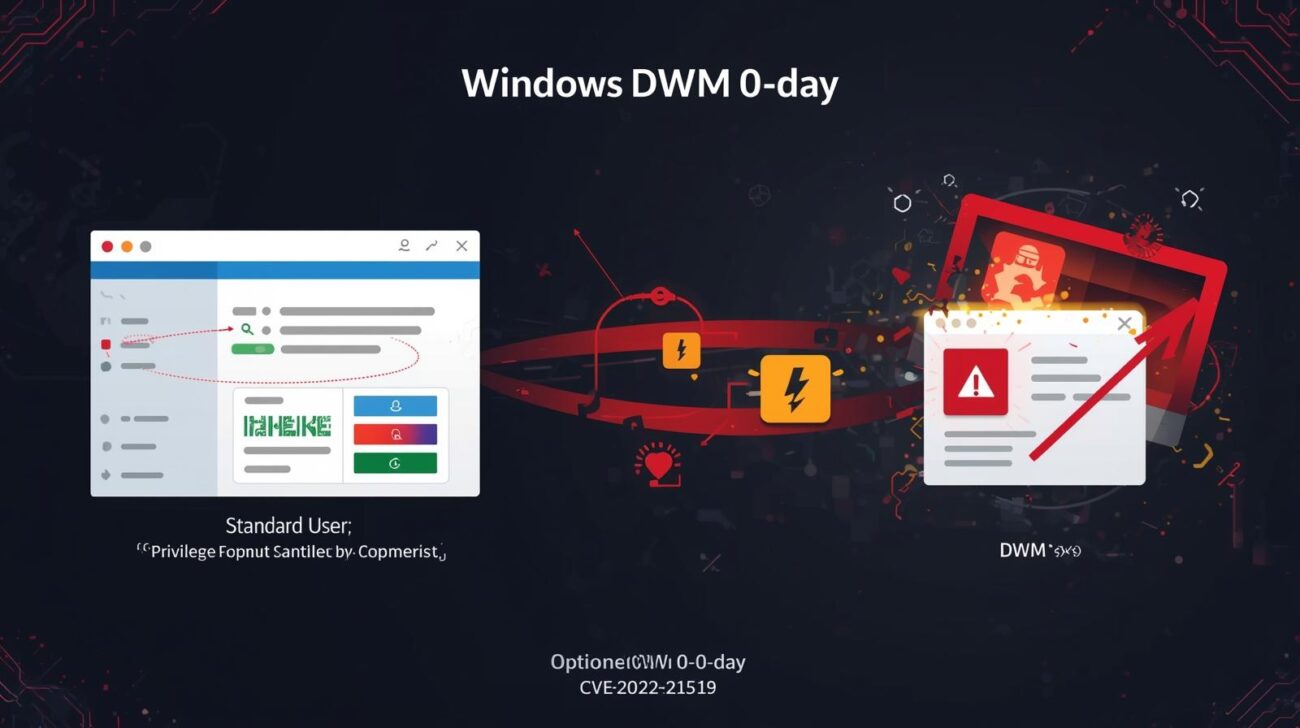
Microsoft has released urgent security updates for a critical zero-day vulnerability in the Desktop Window Manager (DWM), tracked as CVE-2026-21519. This flaw is actively exploited in the wild and allows local attackers to escalate privileges from a standard user to SYSTEM, gaining full administrative control over affected Windows systems.
This article explains the vulnerability, affected versions, attack mechanics, and mitigation strategies to protect organizations and individual users.
Understanding the Vulnerability
The Desktop Window Manager (dwm.exe) is a core Windows process responsible for rendering visual effects:
- Transparent windows
- Live taskbar thumbnails
- High-resolution display support
Because DWM runs continuously in the background and interacts closely with the Windows kernel, improper memory handling can allow attackers to execute malicious code at elevated privileges.
Key Details:
- CVE ID: CVE-2026-21519
- Vulnerability Type: Privilege Escalation / Local Exploit
- CVSS v3.1 Score: 7.8
- Attack Vector: Local, no user interaction required
- Exploit Status: Actively exploited in the wild
The flaw exploits memory mismanagement within DWM, tricking it into executing arbitrary code while interacting with the kernel.
Affected Windows Versions
CVE-2026-21519 impacts a wide range of Windows operating systems:
| Product | Supported Versions |
|---|---|
| Windows 10 | 1809, 21H2, 22H2 |
| Windows 11 | 23H2, 24H2, 25H2, 26H1 |
| Windows Server | 2016, 2019, 2022, 2025 |
Since the vulnerability requires local access, attackers must already have a foothold on the system, such as a standard user account. Once exploited, the attacker can:
- Install software without restrictions
- View, modify, or delete data
- Create accounts with full administrative rights
- Potentially disable security protections
Attack Mechanics
CVE-2026-21519 is a local privilege escalation vulnerability:
- Initial Access: The attacker is logged in with a standard or low-level account.
- Memory Exploit: Malicious code manipulates DWM memory locations.
- Privilege Escalation: DWM executes attacker code in SYSTEM context.
- Full Control: SYSTEM privileges allow complete administrative access, enabling further attacks or malware deployment.
No user interaction is required, making the attack straightforward once local access is obtained.
Mitigation and Best Practices
The only effective mitigation for CVE-2026-21519 is patching. Microsoft included fixes in the February 2026 security updates.
Recommended Actions:
- Immediate Patching
- Apply updates via Windows Update or the Microsoft Update Catalog.
- Account Security
- Enforce strong local account passwords
- Limit standard user access to sensitive systems
- Monitoring and Detection
- Watch for unusual privilege escalations
- Use endpoint detection solutions to alert on DWM process anomalies
- Network Segmentation
- Restrict local account access on high-value systems
- Reduce lateral movement opportunities
There are currently no known workarounds, so patching is critical to prevent exploitation.
Expert Insights
- Active Exploitation: CVE-2026-21519 is being used in real attacks, emphasizing rapid patching.
- High Impact: Exploitation allows full SYSTEM privileges, making follow-on attacks extremely dangerous.
- Core Windows Process: Targeting dwm.exe highlights the risk of kernel-interacting processes in privilege escalation attacks.
FAQs
Q1: What is CVE-2026-21519?
A zero-day in Windows Desktop Window Manager that allows local attackers to escalate privileges to SYSTEM.
Q2: Which Windows versions are affected?
Windows 10 (1809, 21H2, 22H2), Windows 11 (23H2–26H1), and Windows Server (2016–2025).
Q3: Does exploiting this vulnerability require user interaction?
No. Local access is required, but the exploit does not require the user to click or approve any action.
Q4: How can organizations mitigate the risk?
Immediate patching, account hardening, monitoring for anomalous DWM activity, and restricting local account access.
Conclusion
CVE-2026-21519 is a critical zero-day affecting the Windows Desktop Window Manager, actively exploited in the wild. Applying February 2026 security updates immediately is essential to prevent privilege escalation.
Organizations should combine patching with local account management, endpoint monitoring, and network segmentation to mitigate potential follow-on attacks from compromised SYSTEM accounts.
