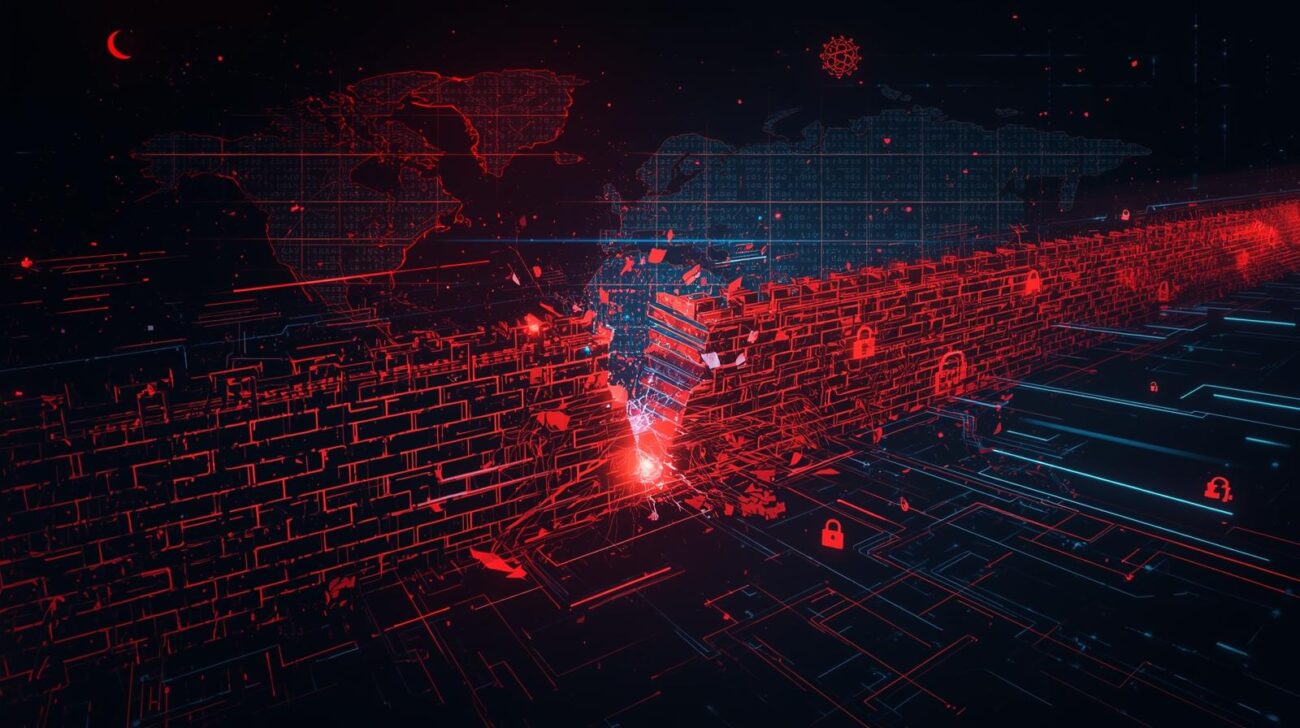
In September 2025, a seismic cybersecurity incident rattled the foundations of one of the world’s most advanced censorship regimes. Over 500 gigabytes of internal data from the infrastructure behind Great Firewall of China (GFW) were exposed—marking what security experts call one of the most consequential leaks in digital-surveillance history.
This trove spans more than 100,000 documents, including source code, work logs, configuration files, internal emails, manuals and operational run-books from Chinese infrastructure firms tied to the censorship apparatus.
1. What Was Leaked
- Source code for DPI (deep packet inspection), filtering modules and build systems.
- Raw IP access logs and PCAPs from state-run telecom providers such as China Telecom, China Unicom and China Mobile.
- Internal metadata showing usernames, hostnames, departmental hierarchies, revision histories—linking documents to individual operators.
- Testbed and sandbox environments referencing evasive technologies like Psiphon, Shadowsocks and V2Ray.
- Exports showing that the same censorship-stack is being offered to foreign regimes in countries like Ethiopia, Myanmar, Pakistan and Kazakhstan.
2. How It Happened: Insider or External?
This was far from a casual leak. The archive appears to be a curated corpus, likely compiled over an extended period—either by a trusted insider with high-level access or through a methodical external exfiltration operation.
The sheer volume, diversity of document types, timestamps and metadata suggest a deliberate accumulation rather than a one-off breach.
3. Implications for China’s Censorship Architecture
3.1. Visibility Into the Black Box
For the first time, researchers and the public gain multidimensional visibility into the internal workings of the Great Firewall: its build systems, enforcement logic, traffic-monitoring infrastructure, and export model.
3.2. Vulnerabilities in a Supposedly Ubiquitous System
The dump reveals moments when the censorship apparatus faltered: for example, foreign IPs establishing unfiltered sessions for extended periods due to delays in rule propagation or failures in detection heuristics. This challenges the view of the GFW as an infallible system.
3.3. Global Export of Censorship Tech
The leak underscores how the GFW-derived technology is not just domestic: it is being commercialised and sold abroad, meaning global risks. Nations looking to control digital flows are now able to acquire a turnkey censorship solution.
4. Why It Matters
- For tech communities and researchers: The leaked source code and logs offer a rich resource to develop improved circumvention tools.
- For human-rights and digital-freedom advocates: The revelations highlight how censorship systems are built, deployed and exported, enabling better advocacy and policy-making.
- For governments and global cybersecurity: The fact that a censorship stack was exposed implicates supply-chain, insider-risk and export-control dimensions previously underexplored.
5. What Comes Next
- Expect intensified efforts by anti-censorship developers to use the leaked data to build evasion strategies targeting DPI & filtering modules.
- Watch for regulatory responses: export controls on surveillance technology may gain renewed traction.
- The Chinese government may respond with damage-control, tighten internal access and possibly pursue attribution or retaliation.
- Further forensic work may trace the leak’s provenance, possibly revealing whether this was internal whistle-blowing or an external hack.
6. Takeaway
The September 2025 leak of over 500 GB from China’s Great Firewall infrastructure marks a pivotal moment in the history of digital surveillance. It shifts the asymmetry: from the censor being opaque and monolithic, to now being exposed and fallible.
What was once a black box is now partially in plain sight—and that changes the balance of power in the global conversation on internet freedom.
